
You Were Taught You Have 5 Senses. You Have at Least 11
Feb 03, 2026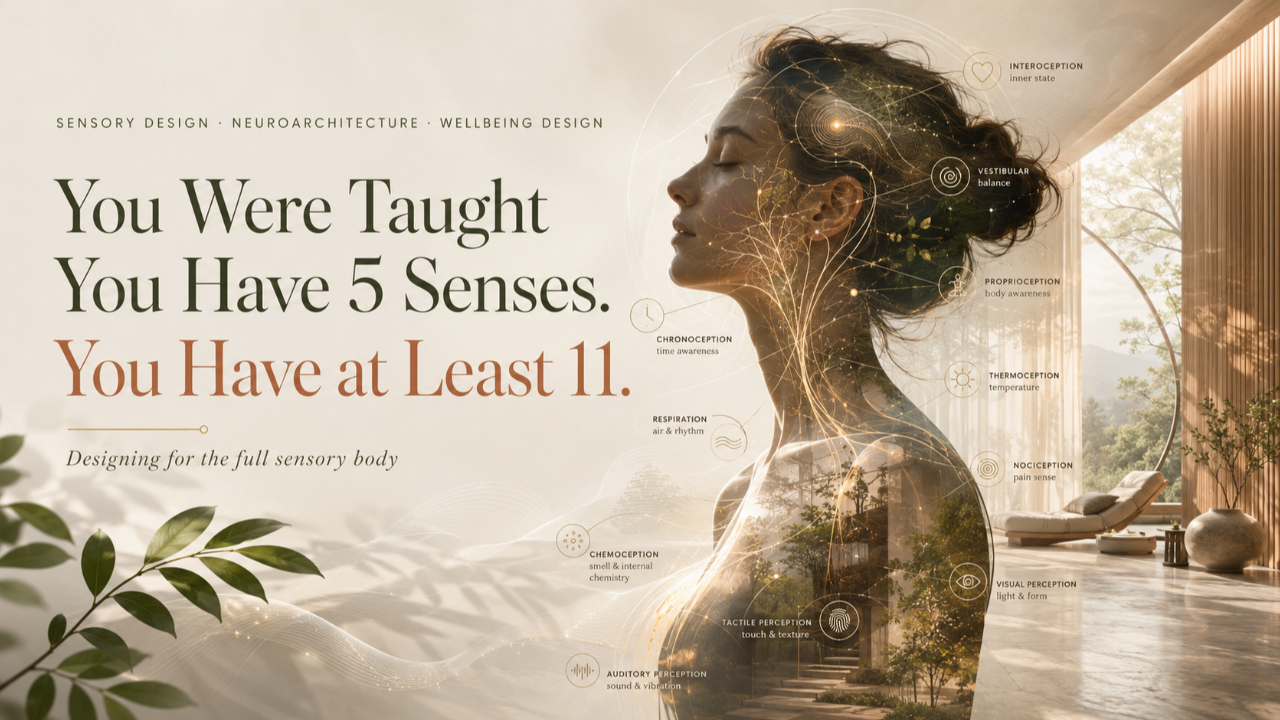
The five-senses model is useful in primary school. In design practice, it leaves out the senses that matter most for wellbeing, the ones that tell your body whether a space is safe, restorative, or quietly depleting you from the inside.
Sight. Hearing. Smell. Taste. Touch. We learned these in childhood, drew diagrams of them, memorised them for exams. And then, in design school, we built entire methodologies around them, principally around the first two.
The problem is not that this list is wrong. It is that it is radically incomplete. And the senses it omits are precisely the ones that determine whether a person feels regulated, restored, and truly at ease in a space, or whether they feel subtly wrong without being able to say why.
Researchers now recognise somewhere between 9 and 33 distinct sensory systems in the human body, depending on how you define and categorise them. At Habitarmonia, we work with at least 11 as a practical baseline for wellbeing design, each one contributing to how a body experiences an environment below the threshold of conscious awareness.
Understanding these senses does not just add nuance to your practice. It changes the questions you ask, the observations you make, and the decisions you reach. It is the difference between designing for a person as the client imagines themselves and designing for a person as their nervous system actually is.
The senses your design school probably skipped
Design relevance: air quality, thermal comfort, acoustic softness
Design relevance: scale, ceiling height, spatial sequence
Design relevance: material warmth, solar orientation, ventilation
Design relevance: daylight quality, artificial light colour temperature, views to sky
Design relevance: flooring, transitions, visual anchoring
Nociception: The sense of pain and physical threat, including micro-signals the body reads as potential harm: sharp edges in peripheral vision, exposed overhead forms, materials that feel hostile to the touch.
Design relevance: material selection, form language, visual safety
And then there are the senses that bridge the body and its environment most directly: the chemical senses beyond taste and smell (including the detection of pheromones and airborne microbial signals), the magnetic sense that orients us to earth's field, and the sense of humidity, which affects respiratory ease in ways occupants feel without naming.
Why this matters more than aesthetics
Most design practice focuses on the visual channel. We compose spaces to be seen, photographed, presented in a certain light. And visual experience is real and important. But consider what the body is actually doing when it enters a new space.
Before you register a single conscious visual impression, your interoceptive system has already begun assessing the air. Your thermoceptive system has noted the surface temperature of what is closest to your skin. Your vestibular system has calibrated to the floor surface and the height of the ceiling. Your chronoceptive system has read the quality of light and begun updating your biological clock. Your proprioceptive system has positioned your body relative to the room's geometry.
All of this happens in milliseconds. All of it shapes whether the body settles or stays vigilant, whether the space feels like somewhere you can exhale or somewhere you remain slightly on guard.
Studies in environmental psychology and neuroarchitecture consistently show that occupant wellbeing is predicted less reliably by visual aesthetic ratings than by multisensory comfort measures: thermal comfort, acoustic quality, air quality, circadian light access, and spatial legibility. In one landmark series of workplace studies, employees who rated their sensory environment highly showed 26% lower rates of reported stress and significantly higher engagement, regardless of whether they considered their office "attractive." The body votes independently of the eye.
Designing for the full sensory body
A multisensory approach to wellbeing design does not mean overwhelming a space with stimulation across every channel. It means attending to each channel with the same care that we currently give only to the visual one.
It means asking, for every space: what is the thermal quality of this room telling the body about safety? What is the acoustic texture doing to the nervous system's vigilance level? What is the light doing to the occupant's circadian rhythm at this time of day? Is there a horizon line for the eyes to rest on, or is the visual field uniformly demanding? Is the air alive, carrying traces of wood or plant or the outside world, or is it recycled and characterless?
These are not luxury considerations. They are the baseline of what it means to design for a human body rather than for a rendered image of one.
And they are learnable. The 11+ senses framework is not a theoretical exercise; it is a practical design audit tool. Once you have internalised it, you will never enter a space again without reading it across every channel, and your design decisions will be richer, more specific, and more genuinely healing as a result.
- Close your eyes for 60 seconds. What does the body register without the visual channel? Temperature, air movement, sound texture, surface beneath your feet.
- Open your eyes and shift your gaze to the periphery. What is the visual field doing at the edges? Is it restful or demanding?
- Notice your posture. Has the space invited you to settle, or are you holding yourself slightly upright, slightly alert?
- Notice the light. Does it feel like the right time of day? Or is there a mismatch between what your body expects and what the room is providing?
- Name one sensory channel this space is not attending to. That gap is your design opportunity.
The five senses were always an incomplete map. The body has always been reading more than we gave it credit for. In wellbeing design, we simply begin working with the full picture.
The 12-Week Certification in Biophilic and Holistic Well-Being Design
The 11+ senses framework is one of the core methodological tools of the certification, taught not just as theory but as a live design instrument you apply to real spaces from week one. Alongside neuroscience, environmental psychology, sacred geometry, and embodied practice, you will learn to design for the full sensory body: the one that actually inhabits the spaces you create.
Explore the certification and reserve your place →Nuria Muñoz Arce
Founder, Habitarmonia Academy
Biophilic Design Educator and Wellbeing Design Mentor
Learn about our services and courses.
At Habitarmonia we want to spread the word about our passion: create healthy and well-being spaces for our customers!
Stay connected with news and updates!
Add your email to the mailing list to receive information on the latest courses and enrolments.
We hate SPAM. We will never sell your information, for any reason.
