
The Hidden Mathematics of Healing Spaces: Sacred Geometry in Design
Jul 06, 2026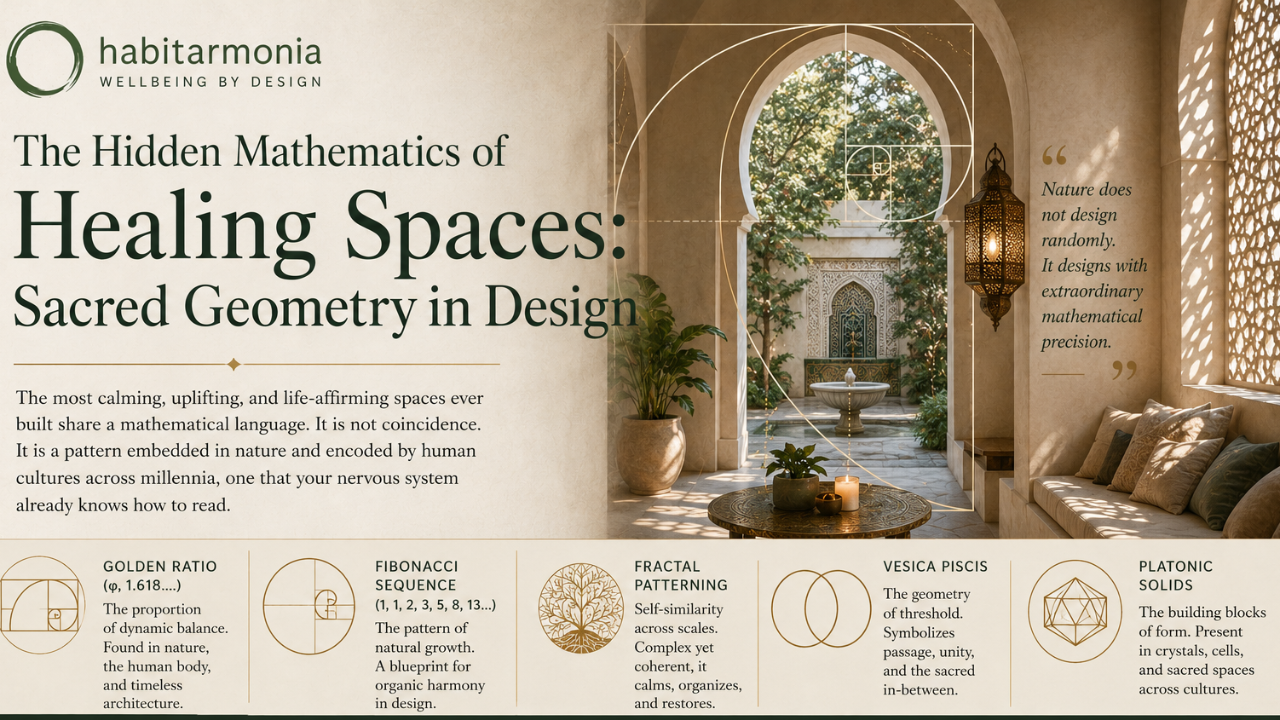
The most calming, uplifting, and life-affirming spaces ever built share a mathematical language. It is not coincidence. It is a pattern embedded in nature and encoded by human cultures across millennia, one that your nervous system already knows how to read.
Stand in the nave of a great cathedral. Walk through the corridors of an ancient temple. Sit in a Japanese teahouse. Enter a traditional Moroccan riad. These spaces were designed in different centuries, by different cultures, with different materials and entirely different spiritual intentions. And yet they tend to produce similar effects in the bodies that inhabit them: a quieting, a sense of being held, a quality of presence that contemporary architecture rarely achieves even at significant expense.
Part of what they share is proportional. The relationships between their dimensions, the geometry of their openings, the ratio of height to width to depth, follow patterns that appear across natural forms, from the spiral of a nautilus shell to the branching of a river delta to the arrangement of seeds in a sunflower. These patterns are what we call sacred geometry: not sacred in a necessarily religious sense, but in the sense of being protected, preserved, and recognised across human cultures as carrying a quality of resonance that ordinary geometry does not.
Understanding these patterns does not require mysticism. It requires curiosity, and a willingness to look more carefully at what some of the most enduring built environments in history have in common.
What sacred geometry actually is
Sacred geometry refers to the geometric patterns and proportional relationships found repeatedly in natural forms and encoded in the architecture, art, and sacred spaces of cultures worldwide. It includes the golden ratio, the Fibonacci sequence, the Platonic solids, fractal patterning, the vesica piscis, and a range of other mathematical relationships that appear with unusual frequency in both the natural world and in the spaces human beings have consistently found most meaningful to inhabit.
What these patterns share is a quality of coherence: an internal mathematical logic that the human perceptual system appears to find intrinsically satisfying. This is not a culturally conditioned preference, it is remarkably consistent across populations and historical periods, which points to something deeper than taste.
Research by Richard Taylor at the University of Oregon has shown that the human visual system responds distinctively to fractal patterns, the self-similar, scale-independent patterns found in natural forms like trees, coastlines, and mountain ranges. Fractal patterns with a dimension between 1.3 and 1.5 (the range most common in nature) produce the strongest stress-reduction response, measurable in electrodermal activity and alpha-wave generation. The golden ratio (approximately 1.618) appears repeatedly in the proportional systems of spaces rated highest for aesthetic resonance and emotional safety across cultures. These findings suggest that sacred geometry is not superstition: it is a description of the mathematical patterns that human perceptual systems have co-evolved with over hundreds of thousands of years, and that they continue to find deeply regulating.
The key patterns and what they do
Sacred geometry across cultures: a shared knowing
One of the most striking things about sacred geometry is not that it exists but that it was arrived at independently by cultures that had no contact with each other. The proportional systems of Egyptian temples, Vedic architecture, Greek classical orders, Islamic geometric art, and Celtic knotwork all encode versions of the same mathematical relationships.
This convergence is not easily explained by diffusion or cultural exchange. It points to something more fundamental: that these patterns were observed in the natural world, recognised as significant, and encoded into built form by people who understood, perhaps intuitively, that the spaces which honoured the mathematics of nature also honoured the human beings who inhabited them.
Contemporary wellbeing design is, in part, a rediscovery of this understanding. Not a reproduction of historical styles, but a return to the underlying principles those styles were attempting to embody.
How to begin working with it
Sacred geometry is not a style overlay to apply to an existing design. It is a proportional language to build from, a way of establishing dimensional relationships from the beginning of a project that will generate coherence throughout.
The simplest entry point is the golden ratio. Before specifying any dimension, ask: how does this relate to the dimensions it will live alongside? Does the height of this opening bear a coherent relationship to its width? Does the depth of this room relate to its width in a way that feels resolved? These are not arbitrary questions. They are the questions that the most enduring architectural traditions have always asked first.
- Choose a room you spend a significant amount of time in. Measure its length, width, and ceiling height (even approximate measurements will do).
- Calculate the ratio of length to width, and of width to height. Are any of these close to 1.618? To 1.5? To 1.333 (a simple 4:3)?
- Now notice how the room feels to you. Is there a sense of resolution in its proportions, or do they feel slightly unresolved, neither intimate nor expansive?
- Find one opening in the room (a window or door). What is the ratio of its height to its width? Is it close to the golden ratio, to a simple integer ratio, or to something in between?
- Consider: if you were to adjust one dimension of this room toward a more coherent proportional relationship, what would it be?
This is the beginning of proportional literacy. With practice, it becomes intuitive: you begin to feel the difference between a coherent and an incoherent room before you measure anything.
Sacred geometry is, ultimately, an act of respect: for the intelligence of natural systems, for the accumulated wisdom of cultures that spent millennia learning what kinds of spaces support human flourishing, and for the bodies that will inhabit the spaces we create. It is design that acknowledges we did not invent beauty. We recognise it, because we evolved in its presence.
The 12-Week Certification in Biophilic and Holistic Well-Being Design
Sacred geometry is one of the ancient wisdom traditions integrated throughout the certification, taught alongside the Platonic solids, Tao geomancy, feng shui, and indigenous spatial practices. You will learn not just the patterns but how to work with them in contemporary design projects, drawing on a thread of knowing that has been refining itself for thousands of years.
Explore the certification and reserve your place →Founder, Habitarmonia Academy
Biophilic Design Educator and Wellbeing Design Mentor
Learn about our services and courses.
At Habitarmonia we want to spread the word about our passion: create healthy and well-being spaces for our customers!
Stay connected with news and updates!
Add your email to the mailing list to receive information on the latest courses and enrolments.
We hate SPAM. We will never sell your information, for any reason.
