
What a Biophilic Design Retreat Does to Your Nervous System
Jun 07, 2026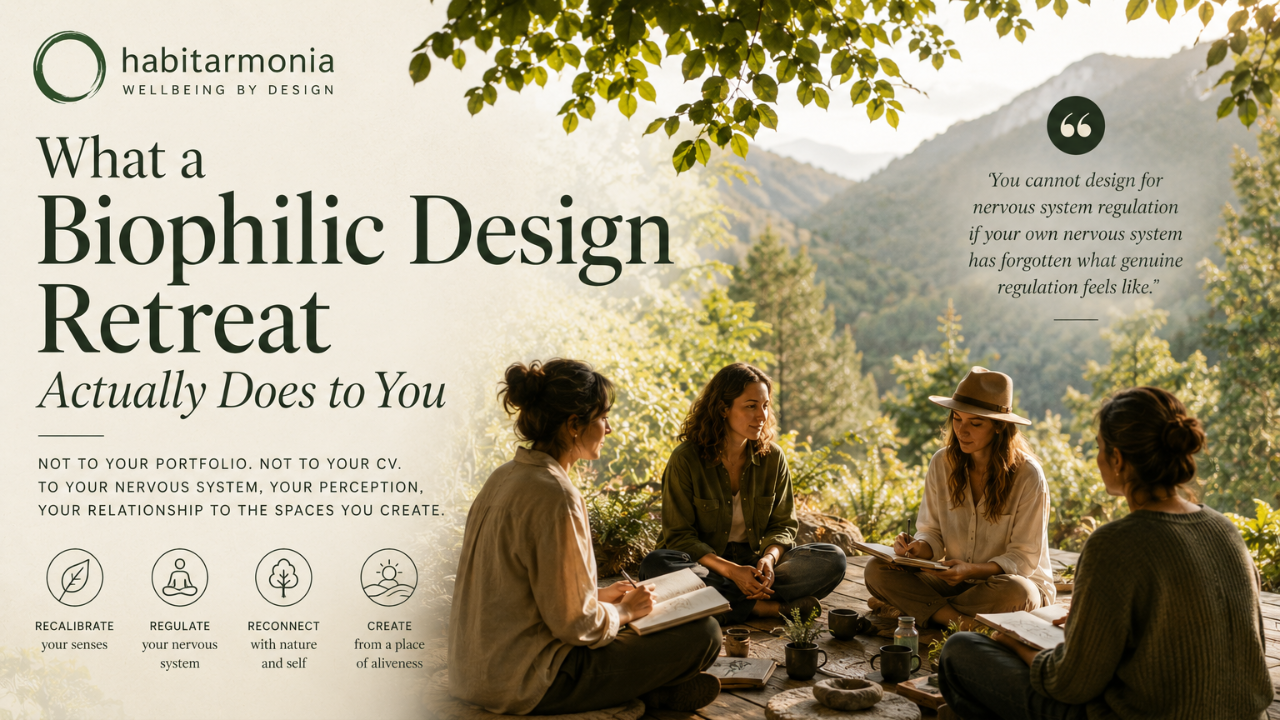
Not to your portfolio. Not to your CV. To your nervous system, your perception, your relationship to the spaces you create. The kind of learning that happens in nature cannot be reproduced in a classroom, and it is not the same thing at a different scale.
There is a particular quality that the best designers seem to have. Not the most technically skilled or the most commercially successful, though those things may follow. It is something harder to name: a quality of presence in the work. A sense that the spaces they create have been genuinely listened into being, that the designer knew, in some felt way, what the space needed before they knew what it would look like.
This quality is not taught in design school. It is cultivated slowly, through a particular kind of practice: the practice of paying attention to the full sensory world with the whole body, over time, in environments that reward that attention.
An immersive biophilic design retreat is one of the most powerful accelerators of that practice I have encountered. Not because of the content delivered, though there is content. But because of what genuine nature immersion does to the instrument doing the designing: you.
What happens to the body in sustained nature immersion
We spend, on average, 90% of our lives indoors. This means that for most designers, the primary environment they inhabit while developing their professional intuition is one that is controlled, filtered, artificially lit, acoustically managed, and almost entirely disconnected from the living systems that shaped human sensory experience over hundreds of thousands of years.
The consequence is not dramatic. It is quiet and cumulative. A gradual narrowing of sensory range. A calibration of what "normal" feels like that is, by evolutionary standards, deeply abnormal. An attenuation of the body's capacity to read subtle environmental signals, precisely the signals that matter most in wellbeing design.
When designers undergo this recalibration, something specific happens to their professional perception. The sensory range that has been narrowed by indoor working life begins to open again. They start noticing things they had stopped registering: the quality of different qualities of silence, the way light moves differently at different times of day, the thermal variation between a shaded space and an open one, the felt difference between materials that are alive and those that are inert.
These are not observations they did not know how to make. They are observations they had forgotten to make, because nothing in their daily environment was asking them to.
What an immersive retreat teaches that a course cannot
A course teaches frameworks. A retreat teaches perception.
The Habitarmonia biophilic design retreat is structured around a sequence that mirrors the nervous system's own process of opening: decompression first, then sensory recalibration, then embodied inquiry, then creative integration, and finally, the question of how to carry what has been learned back into the practice.
The first hours are not about learning. They are about landing. The nervous system needs time to register that it has left the pace of ordinary professional life. This is not wasted time. It is the prerequisite for everything that follows. Without it, the body brings its urban vigilance into the forest, and the forest cannot do its work.
Moving through designed and wild environments with deliberate, guided attention. Forest bathing practices that slow the pace of perception. Multisensory exercises that re-awaken the channels that desk life has quieted. The body begins to remember what it can feel.
The design intelligence that emerges from a recalibrated nervous system is richer, more specific, and more honest than what analytical thinking alone produces. We work with that intelligence directly: through drawing, movement, material exploration, and reflective practice in the landscape itself.
The retreat does not end with a set of takeaways. It ends with a question: what does what you have felt here ask of the work you return to? This is the question that has the longest half-life, and the one that most changes the practice.
What you bring home
Designers who have been through an immersive retreat describe the experience in similar terms, regardless of where they are in their career. They do not describe what they learned. They describe what they remembered.
A renewed capacity to be still in a space before deciding what to do with it. A more honest relationship with their own body's responses as design data. A felt understanding of what genuine biophilic design means, not as an aesthetic category but as a quality of aliveness in a space. And something harder to name: a greater confidence in their own perception, because they have spent several days in an environment that rewarded it.
These are not things that fade when the retreat ends. They are changes in the instrument, and the instrument goes home with you.
- Find twenty minutes outside, without a destination or a purpose other than presence.
- Walk slowly enough that you could stop at any moment without it feeling strange.
- Let your gaze go soft: not focused on anything in particular, open to the peripheral field.
- Notice what your body is registering that you would normally walk past: temperature changes, the sound texture of different surfaces underfoot, the way the light moves differently in different parts of the space.
- Ask yourself: if I were designing a space for the quality of experience I am having right now, what would I need to include? What would I need to let go of?
This is the beginning of design from nature. The retreat takes it much further, over several days, in a genuine living landscape, in a small group of people doing the same work.
The most important design tool you own is not your software or your library or your portfolio. It is your capacity to perceive with precision what a space is doing to the body that inhabits it. The retreat exists to refine that capacity, in the environment that most reliably opens it.
The Habitarmonia Biophilic Design Retreat
An immersive, small-group experience in a living landscape, designed for architects, designers, and wellbeing professionals who are ready to deepen their practice from the inside out. Forest bathing, somatic inquiry, embodied design practice, and the science of the senses, held together over several days in a space that asks nothing of you except presence.
Spaces are very limited. If this is calling you, the best first step is to join the waitlist.
Join the retreat →Founder, Habitarmonia Academy
Biophilic Design Educator and Wellbeing Design Mentor
Learn about our services and courses.
At Habitarmonia we want to spread the word about our passion: create healthy and well-being spaces for our customers!
Stay connected with news and updates!
Add your email to the mailing list to receive information on the latest courses and enrolments.
We hate SPAM. We will never sell your information, for any reason.
