
Forest Bathing for Designers: What Shinrin-Yoku Teaches Us About Space
Jul 20, 2026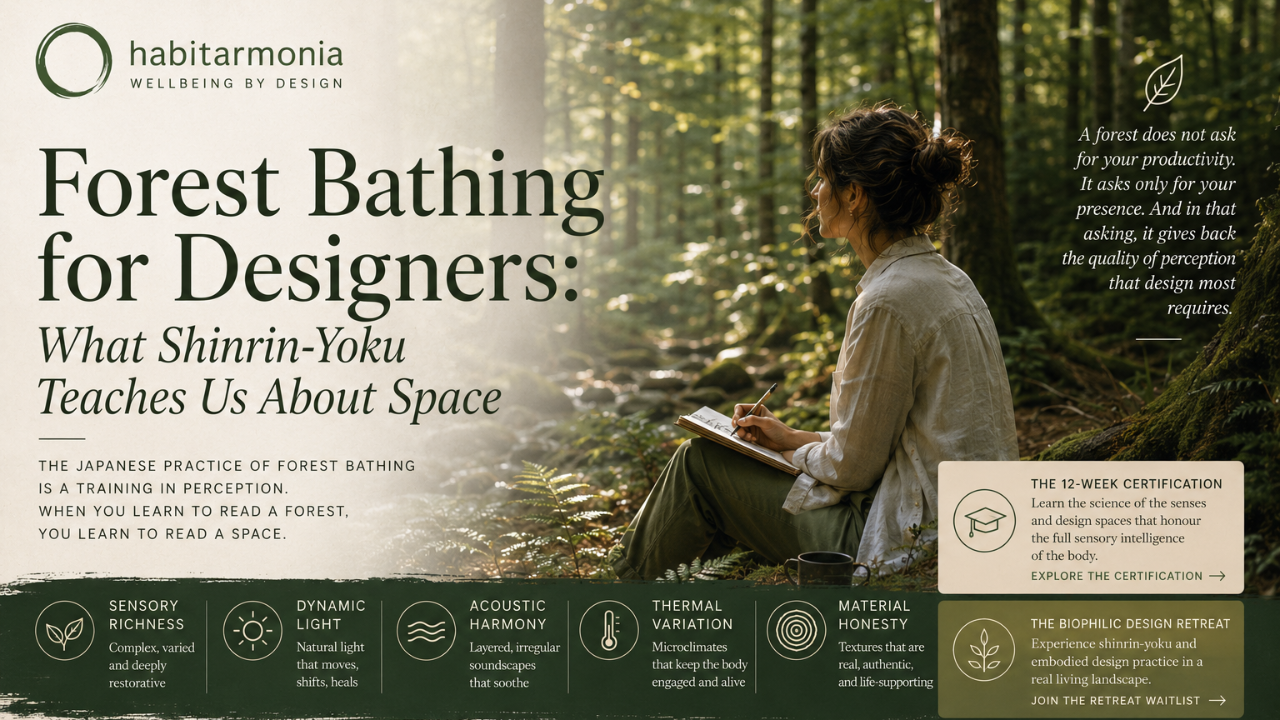
Forest Bathing for Designers: What Shinrin-Yoku Teaches Us About Space
The Japanese practice of forest bathing is not a wellness trend. It is a structured encounter with the sensory intelligence of living systems, and for designers, it is one of the most powerful calibration tools there is.
Shinrin-yoku translates literally as "forest bathing" or, more precisely, "taking in the forest atmosphere." It was formalised in Japan in the 1980s as a public health practice, a response to a society that had become profoundly disconnected from natural environments and was suffering measurably for it. In the decades since, it has been the subject of hundreds of peer-reviewed studies, validated as a clinically significant intervention for stress, immune function, mood, and cardiovascular health.
But for designers, the value of shinrin-yoku goes beyond its health benefits. It is a training in perception, specifically, in the kind of multi-channel, slow, receptive perception that wellbeing design most requires and professional life most consistently prevents.
When you learn to read a forest, you learn to read a space.
What forest bathing actually is
Forest bathing is not hiking. It is not exercise, and it is not birdwatching, and it is not meditation in a park, though it shares qualities with all of these. It is something more specific: an intentional, slow, receptive immersion in a natural environment, with attention distributed across the full sensory field rather than directed at a goal.
A guided shinrin-yoku session typically moves at a pace that most people find startling in its slowness. A kilometre of forest trail might take two hours. The point is not the distance covered but the depth of attention brought to each moment of the walk: the texture of bark, the quality of light filtering through canopy, the changes in air temperature between open and sheltered spaces, the soundscape of a living ecosystem responding to itself.
The body, in this quality of attention, begins to do something it rarely gets to do in professional life. It stops performing. It stops anticipating. It begins, slowly, to receive.
What it teaches designers specifically
A forest is the most sophisticated wellbeing environment on earth. It has been refining its capacity to support biological flourishing for far longer than architecture has existed. When a designer spends time in it with full sensory attention, they are studying, in the most embodied way possible, the principles that biophilic design is attempting to bring into the built environment.
How to bring it back into the work
The question designers often ask after a forest bathing experience is: how do I translate this? The honest answer is that it cannot be fully translated, only approximated. The living complexity of a forest cannot be reproduced in a building. But it can be honoured, brought closer to, gestured toward with intention.
The designer who has spent time in genuine nature immersion returns to their practice with a recalibrated instrument. They notice, more acutely, where the spaces they design fall short of what a body genuinely needs. They make different decisions about natural ventilation, about material selection, about the quality of light, about the presence of living elements, not because they have learned new rules but because their own body now knows the difference more precisely.
This is what shinrin-yoku gives designers that no textbook on biophilic design can: not knowledge about nature, but a renewed intimacy with it. And that intimacy shows up in the work.
- Go to the nearest natural environment available to you: a park, a garden, a tree-lined street. Set aside 30 minutes with no other purpose.
- For the first 10 minutes, walk very slowly with your eyes mostly on the ground. Notice the variety of texture, colour, and form at your feet. Let the visual field remain soft and wide.
- For the next 10 minutes, stop and close your eyes. What does this environment sound like when you are not looking at it? What can you feel on your skin? What can you smell?
- For the final 10 minutes, find something, a leaf, a piece of bark, a patch of grass, and look at it as if you had never seen anything like it. Notice the fractal detail. Notice how long you can stay curious.
- Before you leave, ask: what quality of this environment would I most want to bring into a space I am currently designing? Not literally, but as a quality of experience.
A forest does not care whether you are a designer. It offers its intelligence to anyone willing to slow down enough to receive it. The practice of shinrin-yoku is simply the discipline of slowing down, in the one environment that most reliably makes it worthwhile.
Forest bathing principles and the multisensory science behind them are woven through the certification. Learn to design spaces that honour the full sensory intelligence of the body.
Explore the certification →Experience shinrin-yoku and embodied design practice in a real living landscape, over several days, in a small group. The retreat that recalibrates your instrument.
Join the retreat waitlist →Founder, Habitarmonia Academy
Biophilic Design Educator and Wellbeing Design Mentor
Learn about our services and courses.
At Habitarmonia we want to spread the word about our passion: create healthy and well-being spaces for our customers!
Stay connected with news and updates!
Add your email to the mailing list to receive information on the latest courses and enrolments.
We hate SPAM. We will never sell your information, for any reason.
